




 DE
DE  EN
EN  IT
IT Acceleration Sensors from Montronix
Our acceleration sensors detect vibrations, collisions and movements in real time. With the Pulse Plus and Pulse M12 Plus models, we offer solutions for a wide range of industrial applications, from machine tools to pump systems.
Learn more now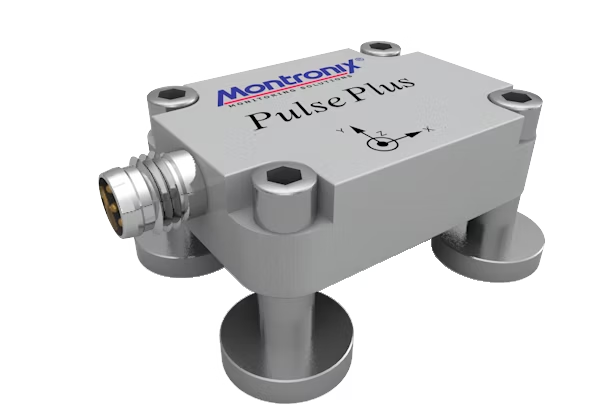
What does an acceleration sensor do?
An acceleration sensor detects acceleration that occurs during movements and vibrations and converts it into electrical signals. It measures how strongly an object accelerates – that is, how quickly its speed changes. In addition to vibration acceleration, this also results in vibration displacement and vibration velocity.
Technically, the measurement is usually based on a small mass-spring system or on MEMS technology (microelectromechanical systems). When the system is moved, a force proportional to the acceleration is generated. This force produces an electrical signal via special materials, such as piezoelectric elements, which can be evaluated.
Such sensors are used wherever movements need to be monitored, analyzed or recorded. This includes, among others, machine tools, production plants, robots, test benches and simply everything that moves. For example, the movable static surveillance cameras on the newly built highway bridge in Genoa after the bridge collapse are also monitored during movement using these sensors.
Acceleration sensors help to detect shocks, vibrations or collisions at an early stage. This makes it possible to avoid damage, reduce downtime and operate machines more efficiently.
How does an acceleration sensor work?
An acceleration sensor measures changes in movement, more precisely, how quickly the acceleration of an object changes. This is done using a small mechanical structure inside the sensor.
Basically, it usually works according to the so-called mass-spring principle: Inside the sensor there is a tiny mass that presses against a spring when moved. This movement is converted into a force. The greater the acceleration, the greater the force.
This physical force acts on a sensitive component, such as a piezoelectric material or a MEMS chip. The material reacts with an electrical voltage or charge that is directly proportional to the acceleration. This signal is then processed and evaluated by the electronics.
The Montronix vibration sensors measure in three axes simultaneously (X, Y, Z). This allows them to detect complex movements or vibrations from all directions. This distinguishes Montronix vibration sensors from many other manufacturers, whose sensors only work with one or two axes and only calculate the third axis.

Acceleration Sensors from Montronix
The Pulse Plus and Pulse M12 Plus acceleration sensors from Montronix offer reliable, high-precision detection of vibrations, shocks and collisions in real time and with minimal effort for installation and operation. Both models are based on modern MEMS technology with 3-axis measurement.

Pulse Plus

Pulse M12 Plus
Technical Data Comparison
When is which sensor the right choice?
Pulse Plus: Use Pulse Plus if you need a high frequency range and have enough space for installation – ideally a flat surface to screw the sensor onto.
It is ideal for applications with complex vibration analysis, such as in milling machines, grinding centers or large systems.
In many applications, screwing is dispensed with and instead the 4 strong magnetic feet (optional) are used. The mobile wear analysis device WiFi Box Plus always uses this sensor in combination with the 4 strong magnetic feet.
Pulse M12 Plus: Choose Pulse M12 Plus if you have little installation space available – e.g. directly on a spindle, in compact axis modules or control cabinets. Ideally, an existing or feasible M12 thread is available.
Despite its small size, it offers the same precise 3-axis measurement as the large Pulse Plus – perfect for typical machine monitoring tasks.
In short:
Pulse Plus = full analysis performance with normal installation space
Pulse M12 Plus = space-saving solution with the full performance of the large Pulse Plus
Need a special solution?
Not every machine is the same. That's why we also offer customer-specific sensor solutions. Whether special design, adapted signal processing or special requirements for temperature, installation space or interfaces: We develop individual variants that are precisely tailored to your application. Special protocols adapted to your data interface, individual calibration or housing modifications are also possible.
Contact us now
What can you use our acceleration sensors for?
Our acceleration sensors are used for monitoring, diagnosing and protecting your machines or moving axes. They detect unwanted movements such as vibrations, shocks or collisions at an early stage – before damage occurs.
Typical areas of application in industry
- Collision monitoring: Detects in real time when tools or axes hit obstacles, thus protecting spindles, tools and machine components.
- Vibration monitoring: Reports imbalances, bearing damage or unstable processes at an early stage.
- Tool monitoring: Monitors the condition of cutters, drills and other tools, e.g. in case of breakage or wear.
- Process optimization: Provides precise data for analyzing and improving your machining processes.
- Machine diagnosis: Helps with troubleshooting and condition monitoring of complex systems, such as machining centers, grinding machines or robots.
- Condition-based maintenance: Supports preventive maintenance through continuous data collection.
Whenever an unwanted influence causes a vibration and this vibration signal exceeds an alarm value that can be freely selected, a reliable alarm signal is sent. What happens then is determined by the operator.
Our sensors can be integrated into a wide variety of machines, including lathes, milling centers, grinding machines, robots, loading portals and special machines – but also wherever else vibrations occur, e.g. in pumps (even under water up to 8 m deep) and aggregates.
In combination with evaluation units such as IBU Plus, IBU Plus NX or the mobile system WiFi Box Plus, they are a powerful solution for the connected industry.
Further applications in technology & industry
Thanks to their robustness, temperature stability and compact design, our sensor solutions are also suitable for demanding environments, e.g.:
- Pump and valve systems (hydraulics & pneumatics): Continuous monitoring for vibrations and malfunctions
- Wind turbines: Early detection of mechanical irregularities in the drive train and generator
- Sewage treatment plants and wastewater technology: Vibration analysis of drives, pumps and agitators
- Recycling and sorting systems: Protection of mechanical components in highly stressed environments
- Dairies and food technology: Condition detection of rotating plant parts, e.g. in filling or packaging lines
- Waste incineration plants: Monitoring of drive modules and conveyor technology
Advantages of Montronix acceleration sensors
Protect machines to avoid downtime
Thanks to the fast response time (≤ 1 ms), the sensors immediately detect collisions, vibrations or overloads. This effectively prevents damage to spindles, tools or drive units – before expensive downtime occurs.
Detect errors early and plan maintenance
The sensors enable continuous monitoring of the machine condition. Irregularities such as imbalances, bearing wear or defective tools are detected at an early stage – the basis for condition-based maintenance instead of unexpected failures.
Save time during installation and commissioning
Our sensors are compact, easy to install and ready for immediate use. Thanks to learning mode and automatic calibration, commissioning is possible without complex configuration – also ideal for retrofit solutions.
Optimize processes to improve your quality
Precise real-time data allows machining processes to be analyzed and specifically improved. This increases tool life, optimizes cycle times and ensures production quality in the long term.
Flexible integration, even in confined spaces
Whether compact machines or complex production systems – thanks to two designs (Pulse Plus & Pulse M12 Plus), the right sensor is available for almost every installation situation. Both can be seamlessly integrated into IBU Plus Kits and the WiFi Box Plus.
Reduce costs through preventive maintenance
With continuous monitoring, wear becomes predictable. Maintenance can be carried out in good time without unnecessarily shutting down machines. This reduces service costs and increases system availability.
Costs in case of incorrect machine operation
There are countless errors that can occur with machine tools: wrong workpiece inserted, correct workpiece inserted incorrectly, wrong fixture installed, wrong tool inserted, wrong tool data stored, wrong machining program selected, etc. – all of which can quickly lead to a collision. No collision protection system in the world can prevent the collision itself, but the Montronix collision protection system helps you reduce the costs of the collision by ensuring that the machine receives the emergency stop signal within 1 ms. It's like an airbag in a car: the car is damaged afterwards, but the valuable thing – the passengers – are protected. In the machine, the tool is usually damaged, but the machine downtime due to a spindle replacement or destroyed fixture, which could result in weeks of downtime, is usually avoided.
We are happy to advise you
Would you like to know which acceleration sensor is best suited to your application? Or are you already planning a specific machine monitoring project? Or do you want to monitor pumps, aggregates or something exotic?
Our team is happy to help. Use the contact form or call us directly.
Frequently asked questions about acceleration sensors
What types of acceleration sensors are there?
There are different types – depending on the area of application. The most common are: MEMS sensors: compact, inexpensive, ideal for many industrial applications (e.g. Montronix). Piezoelectric sensors: very sensitive, especially suitable for high-frequency vibrations. (Not used by Montronix) Capacitive sensors: measure slow movements with high accuracy. (Not used by Montronix) Montronix relies on MEMS technology because it is robust, precise and versatile.
How are the sensors installed in machines?
Montronix sensors can be mounted directly on the spindle, on axis modules, on work tables or in the control cabinet. The connection is made via a standardized M8 connector. Commissioning is particularly easy thanks to an automatic learning mode, even for retrofitting.
Are the sensors compatible with my existing systems?
Yes, both Pulse Plus and Pulse M12 Plus are fully compatible with the IBU Plus Kits and the WiFi Box Plus. This means that even older machines or mixed systems can be monitored without complex control system adjustments.
How are the sensors typically used for collisions?
The sensor is mounted where you expect to feel a collision mechanically, e.g. on the back of a typical motor spindle or on a work table. The sensor is connected to its evaluation unit, which is usually installed in the control cabinet, via a cable. The evaluation unit is connected to the control system via Profibus or Profinet or via inputs/outputs, and the emergency stop signal is always hardwired to the control system at its fast input. Integration via Profibus, Profinet or inputs/outputs is used so that many more scenarios with different limits can be set and monitored, and above all, automatic wear detection is necessary. However, collision protection via a freely selectable limit is also possible without this integration.
Doesn't my control system protect against collisions?
Most control systems protect against collisions, but much later than a Montronix collision protection system. When a spindle causes a collision, the control system usually thinks it needs to apply more force because there is resistance in the way, e.g. a cavity in the casting of the workpiece. At some point, the control system also notices that a limit has been exceeded, but by then valuable time has been lost. The Montronix collision protection system informs the control system within one millisecond (< 1 ms) that it should stop the feed, which is why the costs of the collision are usually much lower. In the best case, a cutting insert or a drill breaks in a machining center for a few euros, but the workpiece, fixture and spindle remain undamaged. Just try it out and ask Montronix for a loan unit in your machine, then you can see for yourself in your own machine.