





 DE
DE  EN
EN  IT
IT Detect and prevent defective production and downtime in unmanned manufacturing with Montronix systems
With our sensors for power, vibration, and force, you can detect deviations from the planned machining process early and reliably. This protects your machine from unplanned downtime during unmanned production and ensures consistently high machining quality. Montronix provides suitable solutions for this application.
Learn more now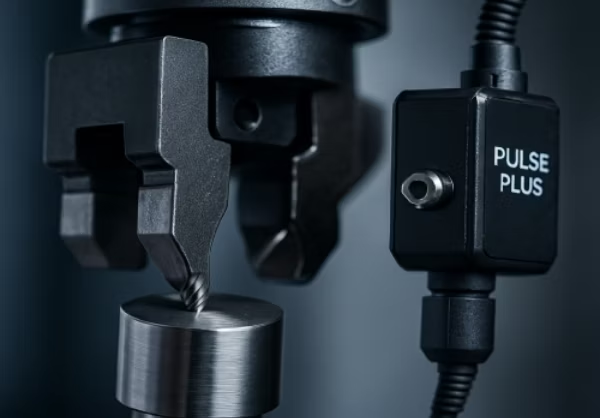
Detecting machine downtime and defective production: The underestimated risk in manufacturing
Staff shortages affect most machine operators. They cannot find qualified, motivated, and at the same time affordable machine operators. This situation therefore requires an alternative strategy: unmanned production.
The challenge lies in monitoring automated processes so that everything runs as planned by you, the machine operator — from loading workpieces, through machining, to unloading. That is exactly why we have developed systems that continuously monitor the condition of your loading devices and the machining process.
Types of monitoring in unmanned production
Automatic loading and unloading by robot or loading portal: Collision
Here, for example, the moving workpiece can be monitored for collisions. Usually, a vibration sensor on the travel axis (portal axis, robot arm, spindle, or table) is sufficient to detect a collision within one millisecond and report it to the control system. This usually prevents major damage.
Automatic loading and unloading by robot or loading portal: Incorrect grip
Using Montronix strain sensors, the gripping force of a robot or loading portal can be checked. This allows detection within one millisecond if a gripper “grabs into thin air,” the workpiece has an unexpected shape at the usual gripping point, or the gripper fingers are not properly positioned on the workpiece.
Machining in the machine: Monitor the entire process
With the right sensor, the entire machining process can be monitored, from
- tool collisions (vibration sensor)
- to detection of a wrong tool (power sensor),
- detection of tool breakage (acoustic sensor or power sensor)
- or cutting edge micro-chipping (force sensor or power sensor),
- excessive workpiece allowances (power sensor),
- missing pre-machining (vibration sensor or power sensor),
— in short, anything that leads to an anomaly in machining, meaning a deviation from the normal machining of a good workpiece.
How can processes be ensured in unmanned production?
Our systems detect the smallest changes in the machining process — and, if desired, also in the loading/unloading process — before they cause problems. We combine three sensor types for maximum reliability:
Power Sensor PS200-NG
The PS200-NG measures the active power directly on the spindle and feed drives. Even the smallest changes in the force curve over time are detected within 1 microsecond, e.g., with dull cutting edges or unsuitable material. The sensor immediately reports this deviation to the system. This helps you avoid scrap and detect tool wear long before dimensional accuracy is affected.
The system also detects incorrect pre-machining if the power is too low (e.g., pre-drill hole diameter for threading too large) or too high (e.g., pre-drill hole diameter too small). If there is too much allowance, the power demand during drilling is triggered earlier than with good workpieces; if too little, it is triggered later.
Special features:
- Responds to ±0.25% power change
- Operates independently of the control system
- Direct connection via M8 connector
- Ideal for series production and small milling tools

Vibration Sensor Pulse Plus
The Pulse Plus is a 3D sensor that measures vibrations in all three spatial axes (X, Y, Z). If the vibration behavior of a tool changes — e.g., due to initial wear, imbalance, or workpiece anomalies — the sensor reports this change in real time. This allows you to detect process deviations before damage occurs. The sensor is also particularly effective for collisions and bearing damage.
Special features:
- MEMS technology with 3-axis measurement
- Data rate up to 26,667 values/second per axis
- Mounting with magnetic base or screw thread
- Ideal for machining centers, grinding machines, robots

Force Sensor RetroBolt
The RetroBolt measures the actual cutting force on the tool. If the force deviates from the reference — e.g., due to dull cutting edges or chip jamming — the system triggers an alarm. The sensors can be integrated directly into existing machines, for example under screw connections. Especially in turning processes, the RetroBolt provides highly precise information about tool load and makes early tool wear or micro-chipping visible.
Special features:
- Direct mounting under existing screw points
- High resolution even for micro-chipping
- Can be combined with Spectra ONE for analysis
- Usable in multi-spindle and special machines

Overview of components for tool wear detection
Why monitoring unmanned production is worthwhile
Monitor automated loading and unloading of workpieces
Our system detects when a workpiece collides with an object during loading into the machine. It also monitors whether the grippers/gripper fingers of the loading system apply the correct pressure and whether the robot or loading portal has released the workpiece in time before it is clamped in the fixture. This ensures safe automatic workpiece transfer even without an operator.
Detect deviations in the loaded workpiece
The Montronix system continuously compares the actual values of the current machining measured by the sensors with the target values of a properly machined workpiece. Any deviations in signal level or timing must not exceed the small tolerance specified by the machine operator. This ensures in series production that each workpiece looks the same, regardless of whether drills are broken, pre-machining was not to specification, material properties differ, tools are worn, or other possible machining process anomalies occur on a machine tool.
Avoid scrap and rework
Our system detects deviations from the target machining as soon as there is the slightest increase in the signal. This allows the Montronix system to stop series production immediately and avoid costly rework.
Increase machine availability
Real-time alerts prevent downtime due to tool breakage or spindle damage. Your machines run reliably, even in unmanned operation or with frequent staff changes.
Typical applications
Our systems are suitable for all industries with machining, automation, or high quality requirements. Anywhere tools are used and their condition is critical.
- Loading portals and robots benefit from precise detection when “empty gripping” or failing to open grippers/gripper fingers when releasing.
- Machining centers, milling machines, and lathes ensure machining quality in series production and with changing materials.
- Special-purpose machines receive customized sensor solutions for specific requirements.

Our services
- System consulting & configuration: We analyze your requirements and recommend the right components, taking into account machine type, process, control system, and budget.
- Installation & commissioning: Our technicians carry out the installation for you or assist you during installation.
- Trial setup & pilot projects: Want to see how well it works first? No problem. We can provide our system on a trial basis.
- Training & support: We train your staff in its use and provide the know-how for safe operation. We are always available to answer questions.
Contact
Would you like to know which system is right for your machine? Or start a pilot project right away? Then write to us or call us. We provide individual, practical advice.
Send request nowFAQ: Frequently asked questions about unmanned production and our systems
How exactly does the system detect if a gripper grabs into thin air?
The jaws of the gripping system are monitored with strain sensors. If the gripper or gripper fingers grab into thin air during the gripping process, the signal will not match that of a proper grip. The system detects and reports this deviation. What happens next is determined by the operator. One option is for the Montronix system to automatically send an email to various colleagues, e.g., in maintenance, production planning, or the shop supervisor, including the alarm as text and graphic. They can then take further action. Alternatively, the machine light or horn could be activated, or the machine could simply be stopped.
Is the system also suitable for older machines?
Yes, our sensor solutions are designed to be completely control-independent. They can be integrated directly into the existing CNC control via inputs and outputs. Many customers retrofit their existing systems with them.
How long does installation take?
Depending on what you want to safeguard against, installation takes one to three days per machine. The sensors are compact and easy to mount. They connect directly via preconfigured plugs. Calibration or manual adjustment is usually not necessary, as many systems operate with a learning mode. Even in retrofit projects, installation is straightforward without significantly interrupting production.
Do I need to teach the system?
Yes, you record a reference cycle at the start, which serves as the basis for later evaluation. This process takes only a few minutes and is carried out directly in production. Machine operator–defined personnel can change the tolerance bands via passwords. This allows the system to take different allowances into account for different casting batches.
Can I test the system before purchase?
Yes, we offer a trial installation directly on your machine if desired. This allows you to experience the functionality in your own environment with your workpieces and processes. Our experts assist with installation and show you exactly how to record and interpret process data. This lowers the entry barrier and gives you confidence in your investment decision.