




 DE
DE  EN
EN  IT
IT Acoustic Sensors: What You Need to Know
Acoustic sensors detect sound waves and convert them into electrical signals. Whether for machine monitoring, leak detection, or quality control, they respond to even the smallest noises that the human ear cannot perceive. This allows problems in production to be detected early, failures to be avoided, and processes to be efficiently secured.
Learn more now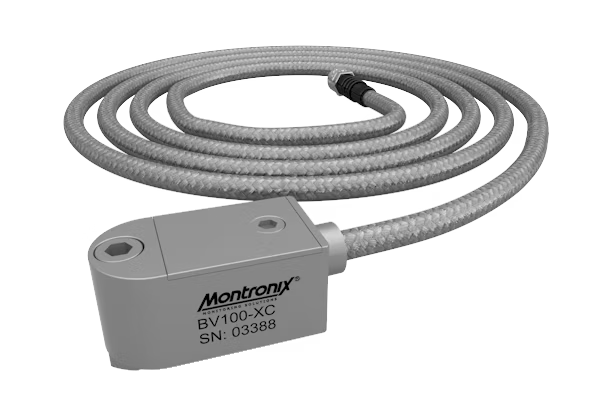
Why Acoustic Sensors are Necessary in Tool Monitoring
Tool breakage, air cuts, or material cracks generate high-frequency signals between 50 and 400 kHz. These occur directly in the machining process, for example at the first contact between tool and workpiece or when a micro drill breaks. Classic vibration sensors do not detect such impulses because they only work in the lower frequency range.
Acoustic sensors like the BV100 close this gap. It measures structure-borne sound signals directly on the machine structure and detects errors before damage occurs. The sensor works like a technical microphone and delivers a real-time analog signal to the evaluation unit.
The monitoring runs continuously in the background. The BV100 detects any irregularity in the process, and the Spectra One evaluation unit intervenes automatically if a threshold is exceeded. This way, the system detects breakages even when no one is at the machine.
Typical Areas of Application
- Milling and turning machines: The BV100 detects tool breakage, spindle errors, and collisions directly at the first signal.
- Micro tools and fine processes: The sensor detects contact errors and tool breakage with tool diameters under 3 millimeters.
- Grinding machines with high speeds: Structure-borne sound makes incipient bearing damage or imbalances visible at an early stage.
- Pumps, drives, and rotating units: The sensor reports changes in vibration behavior even outside of machining.

Technical Data of the BV100 Acoustic Sensor from Montronix
Product Advantages of the BV100 Acoustic Sensor
Error detection via structure-borne sound
The BV100 detects structure-borne sound in the range up to 400 kHz. This means it also registers extremely short signals, such as those that occur during tool breakage or before contact with the material. This makes monitoring reliable even for the smallest tools.
Suitable for micro tools
The sensor detects signals from drills or cutters with less than 3 millimeters diameter. Classic sensors fail with these tools. The BV100 protects your processes even in fine machining.
Effortless installation
You attach the BV100 to the machine with just one screw. The cable is pre-assembled and fits into any production area. Retrofitting is quick and does not require intervention in the control system.
Robust design
The stainless steel housing permanently protects the acoustic sensor from oil, coolants, and chips. The IP67 protection class allows use even in wet areas. Even strong vibrations do not affect its function.
Clear and usable signals
With 100 millivolts per g, the sensor provides a precise, analog output signal. The low output resistance ensures that the signal reaches the evaluation unit without loss.
Optimal system integration
The BV100 is perfectly matched to the associated TSVA2 DGM amplifier and the Spectra One evaluation unit.
Contact
Would you like to test or use acoustic sensors like the BV100? Then send us your inquiry now. We will advise you personally and, if desired, provide a complete test setup.
Send inquiry nowFAQ: Frequently Asked Questions about the BV100 Acoustic Sensor
How does the BV100 acoustic sensor work?
The BV100 uses piezoelectric technology and measures vibrations in the range from 0.1 hertz to 500 kilohertz. It detects high-frequency structure-borne sound generated by contact, friction, or tool breakage. The signal runs from the sensor via a shielded cable to the TSVA2 DGM amplifier, which filters it and passes it on to the SPECTRA electronic unit. There, the evaluation takes place and, if necessary, the automatic reaction. You mount the sensor to the machine with just one screw. It works independently of the control system and is also suitable for retrofitting in existing systems.
Why does the BV100 detect more than a classic vibration sensor?
The BV100 covers frequencies up to 500 kilohertz, while classic vibration sensors only cover about 10 kilohertz. Many process errors such as breakages or contact errors generate very short, high-frequency signals. Only the BV100 makes these audible and analyzable. This allows you to detect problems before visible damage occurs.
Can I use the BV100 on an old machine?
Yes, the BV100 works independently of the machine control. It transmits an analog signal to the evaluation unit. This makes the sensor particularly suitable for retrofitting in existing systems or mixed machine parks.
How do I find the right mounting point?
Our team will help you select the position. It is important that the sensor is as close as possible to the machining point, for example near the workpiece holder, tool holder, or spindle headstock. As part of a test setup, we will check together whether the signal is meaningful and adjust it if necessary.
What happens if the sensor detects a problem?
If the signal exceeds a set threshold, the system immediately reports an event. The SPECTRA evaluation unit can automatically stop the machining process or send a warning signal. This prevents consequential damage and stops faulty processes at an early stage.
Can I also combine the BV100 with other sensors?
Yes. You can combine the BV100 with force sensors, strain sensors, or power sensors. The signals complement each other and provide a complete picture of the machine's condition. This way you can reliably secure even complex processes.